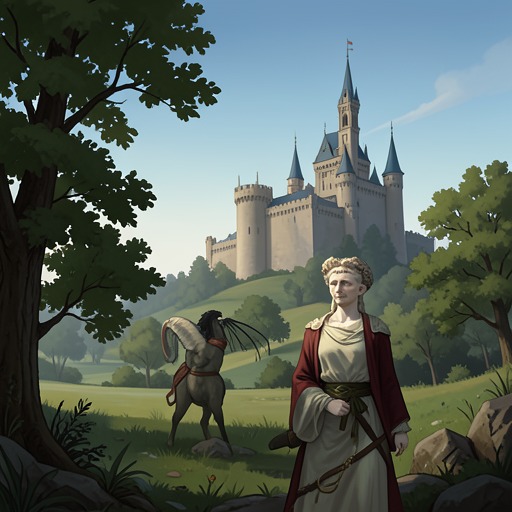
King Peter
The Horse and His BoyKing Peter is the High King of Narnia during the Golden Age, and his name carries both military authority and diplomatic weight in The Horse and His Boy. Though he does not appear in the supplied scenes, other characters invoke his victories and judgment as they weigh the threat from Calormen—and the limits of distant power when danger is already at hand.
Identity and Reputation
King Peter rules as High King above his brother and sisters, who are themselves King and Queens under him. The adventure is set in this Golden Age, establishing his reign as the political order within which the story’s journey and conflicts unfold.
His authority is remembered beyond Narnia. In Tashbaan, Edmund says that Peter had defeated the Tisroc many times over. Yet that record does not make the Narnian party feel secure: Edmund insists that the Queen and the envoys could be killed long before Peter could win a war against Calormen. Peter’s reputation is powerful, but it cannot serve as an immediate shield for people trapped in a hostile city.
A Threat to Narnia and Archenland
Edmund suspects the Tisroc’s interest in the proposed marriage may be more than a personal or dynastic overture. The Tisroc may have sought an occasion to act against Narnia, which he and his lords regard as a small borderland beside a great empire. Edmund fears that the empire’s ambition reaches beyond Narnia to Archenland as well: it may hope to swallow both kingdoms.
The danger is made explicit in Rabadash’s argument to his father. He dismisses Narnia as too small to matter, claims that a thousand spears could conquer it in five weeks, and calls it an unwelcome blot on the empire. The Tisroc agrees with the contemptuous view that free neighboring countries are disorderly and unprofitable. In this exchange, Peter’s kingdom is discussed not as a peer but as territory to be subdued; the High King’s military reputation has not erased the imperial appetite for conquest.
Diplomacy and the Queen’s Vulnerability
Rabadash assumes that Peter will respond to the rejected marriage with political calculation rather than insist on his sister’s return. He argues that the High King is prudent and understands the supposed honor and advantage of an alliance with the Tisroc’s house. By that reasoning, Peter would accept a marriage that could place the Tisroc’s descendants on Calormen’s throne rather than challenge the arrangement.
That calculation is part of Rabadash’s plan to keep the Queen in Tashbaan. He proposes claiming that he acted without his father’s knowledge or blessing, then sending fabricated letters in the Queen’s name to make it appear that she loves him and does not wish to return to Narnia. He expects that even if Peter doubts the letters, he will not risk an armed expedition to retrieve her. The scheme treats the High King’s prudence as a restraint that can be manipulated, while Edmund’s assessment emphasizes the immediate danger: in the city, the Queen might become the prince’s wife or, more likely, his slave before Narnia could intervene.
Narrative Role
King Peter’s presence in the story is chiefly political and indirect. He is the measure by which the Narnian envoys judge the scale of the danger, the imagined defender whom Rabadash expects to deter with false appearances, and the ruler whose past victories cannot guarantee safety in the present crisis. His offstage role sharpens the contrast between a kingdom’s recognized strength and the vulnerability of its people when they are isolated far from home.